Dreaming of the Prophet Muhammad ﷺ
Description and Shamail of Prophet Muhammad ﷺ
Fri Sep 06 2024
Watch the Video: https://youtu.be/kYd_uuu3bo8
Table of Contents
- Introduction
- Prophet's Grave (Hujrat al-Nabi) ﷺ
- Blessed Birth of the Prophet ﷺ
- The Prophet ﷺ speaks about his own birth
- Date of Birth of the Prophet ﷺ
- Moment He ﷺ was Appointed as a Prophet
- The Prophet ﷺ is the Best of Creation
- Type of Prophetic Studies
- Features of the Prophet ﷺ (Khalq)
- General Appearance of the Prophet ﷺ
- Blessed Stature of the Prophet ﷺ
- Blessed Complexion of the Prophet ﷺ
- Blessed Face and Countenance of the Prophet ﷺ
- Blessed Hair of the Prophet ﷺ
- Blessed Physique of the Prophet ﷺ
- The Blessed Seal of Prophethood
- Blessed Presence of the Prophet ﷺ
- Umm Mabad Describes the Prophet ﷺ
- Blessed Beauty of the Prophet ﷺ
- ~~أنشودة: قَمَرٌ~~
- Blessed Speech of the Prophet ﷺ
- Blessed Character of the Prophet ﷺ (Khuluq)
- Blessed Sustenance of the Prophet ﷺ
- Tireless Worship of the Prophet ﷺ
- Concern of the Prophet ﷺ for His Ummah
- ~~***نعت: تاجدارِ حرم***~~
- Passing Away of the Prophet ﷺ
- The Intercession of the Prophet ﷺ (Shafaah)
- Hadith of My Brothers (Ikhwani)
- Dreaming of the Prophet ﷺ
- What Should We Do?
- Footnotes
Introduction
الْحَمْدُ لِلَّهِ الَّذِي اطّلَعَ فِي سَمَاءِ النُّبُوَّةِ سِرَاجًا لَامِعًا وَقَمَرًا مُنِيرًا، وَاطَّلَعَ مِنْ أَكْمَامِ الرِّسَالَةِ ثَمَرًا يَانِعًا وَزَهْرًا مُنِيرًا، تَبَارَكَ اسْمُهُ وَتَمَّتْ كَلِمَتُهُ وَعَمَّتْ نِعَمُهُ وَجَمَّتْ حِكْمَتُهُ، ... وَأَشْهَدُ أَنْ لَا إِلَهَ إِلَّا اللَّهُ وَحْدَهُ لَا شَرِيكَ لَهُ إِلَٰهًا وَاحِدًا أَحَدَا، فَرْدًا صَمَدَا، لَمْ يَتَّخِذْ صَاحِبَةً وَلَا وَلَدَا... [1]
All praise is due to Allah, who has illuminated the sky of Nubuwwah with a shining lamp and a moon munira, and who has brought forth from the buds of the message ripe fruits and flowers munira. Blessed is His name, His word is fulfilled, His blessings are abundant, and profound Wisdom of the Hakima. I bear witness that there is no deity but Allah, alone without partner, one God, unique and incomparable, Wahidan Ahadan Azima.
وَأَشْهَدُ أَنَّ سَيِّدَنَا مُحَمَّدًا عَبْدُهُ وَرَسُولُهُ نَبِيٌّ مَا ضَلَّ وَمَا غَوَى، {وَمَا يَنْطِقُ عَنِ الْهَوَى} {وَلَقَدْ رَآهُ نَزْلَةً أُخْرَى، عِنْدَ سِدْرَةِ الْمُنْتَهَى، عِنْدَهَا جَنَّةُ الْمَأْوَى}، وَسَمِعَ صَرِيفَ الْأَقْلَامِ بِالْمُسْتَوَى، وَكَتَبَ الرَّحْمَٰنُ اسْمَهُ عَلَى الْعَرْشِ إِذِ اسْتَوَى، وَآذَنَ بِاسْمِهِ فِي الْمُبْتَدَأِ فِي الْأَرْضِ وَفِي السَّمَاءِ وَيَوْمَ النَّشْأَةِ الْأُخْرَى.
I bear witness that Sayyidina Muhammad is His servant and messenger, a prophet who neither strayed nor was misled, ghawa; "nor does he speak from his own hawa"; "and indeed, he saw him another time at Sidrat al-Muntaha, next to Jannat al-Mawa." He heard the creaking of the pens in the highest realms of the Mustawa, and al-Rahman wrote His name on the Throne when He Istawa. His name was announced at the beginning in the heavens and the earth, and on the Day of the External Existence, al-Nashat al-Ukhra.
سَلَّمَ عَلَيْهِ الْحَجَرُ وَالشَّجَرُ، وَدَرَّ لَهُ ضَرْعُ الْجَذْعَةِ بِالدُّرَرِ، وَحَنَّ الْجِذْعُ لِفِرَاقِهِ حَتَّى خَارَ خُوَارَ الْبَقَرِ، وَنَبَعَ الْمَاءُ مِنْ أَصَابِعِهِ وَمِنَ الْأَرْضِ انْفَجَرَ، وَانْشَقَّ لَهُ، وَكَانَ يُنَاغِيهِ فِي مَهْدِهِ الْقَمَرُ،...
The stone greeted him and the shajar, the udder of the young she-goat overflowed with milk for him like pearls and durar, and the tree trunk yearned for him until it moaned like cows, the baqar. Water gushed from his fingers, and the earth split open for him like al-Fajr, and conversed with him in his cradle the heavenly bodies and al-qamar.
صَلَّى اللَّهُ عَلَيْهِ وَسَلَّمَ صَلَاةً تَسْعَدُ عِنْدَ الْمَمَاتِ، وَتُسْعِفُ عِنْدَ أَهْوَالِ الْمَسْأَلَةِ بِالثَّبَاتِ، وَتُجِيزُ عَلَى الصِّرَاطِ، إِذَا كَثُرَ الزَّالُونَ وَالزَّلَاتِ.
May Allah’s peace and blessings be upon him, a prayer that brings happiness at the time of death, the mamat, assistance in the terrors of the questioning with firmness, and passage across the Sirat, when many will slip and falter, the zaalun and the zallat.
وَعَلَى آلِهِ وَصَحْبِهِ نُجُومِ الْهُدَى، وَلُيُوثِ الْعِدَى، وَغُيُوثِ النَّدَى، ...
And upon his family and companions, the stars of guidance, the lions in battle, and the showers of grace and radiance.
وقال سبحانه بعد: أعوذ بالله من الشيطان الرجيم﴿هُوَ الَّذِي أَرْسَلَ رَسُولَهُ بِالْهُدَىٰ وَدِينِ الْحَقِّ لِيُظْهِرَهُ عَلَى الدِّينِ كُلِّهِ وَلَوْ كَرِهَ الْمُشْرِكُونَ ﴾ (سُورَةُ التوبَة ٩:٣٣)
9:33 It is He who has sent His Messenger with guidance and the religion of truth to manifest it over all religion, although they who associate others with Allah dislike it.
﴿وَمَا أَرْسَلْنَاكَ إِلَّا رَحْمَةً لِلْعَالَمِينَ ﴾ (سُورَةُ الأنبيَاء ٢١:١٠٧)
21:107 And We have not sent you, ˹O Muhammad˺, except as a mercy to the worlds.
﴿إِنَّ اللَّهَ وَمَلَائِكَتَهُ يُصَلُّونَ عَلَى النَّبِيِّ ۚ يَا أَيُّهَا الَّذِينَ آمَنُوا صَلُّوا عَلَيْهِ وَسَلِّمُوا تَسْلِيمًا ﴾ (سُورَةُ الأحزَاب ٣٣:٥٦)
33:56 Indeed, Allah confers blessing upon the Prophet, and His angels ˹ask Him to do so˺. O you who have believed, ask ˹Allah to confer˺ blessing upon him and ask ˹Allah to grant him˺ peace.
Prophet's Grave (Hujrat al-Nabi) ﷺ
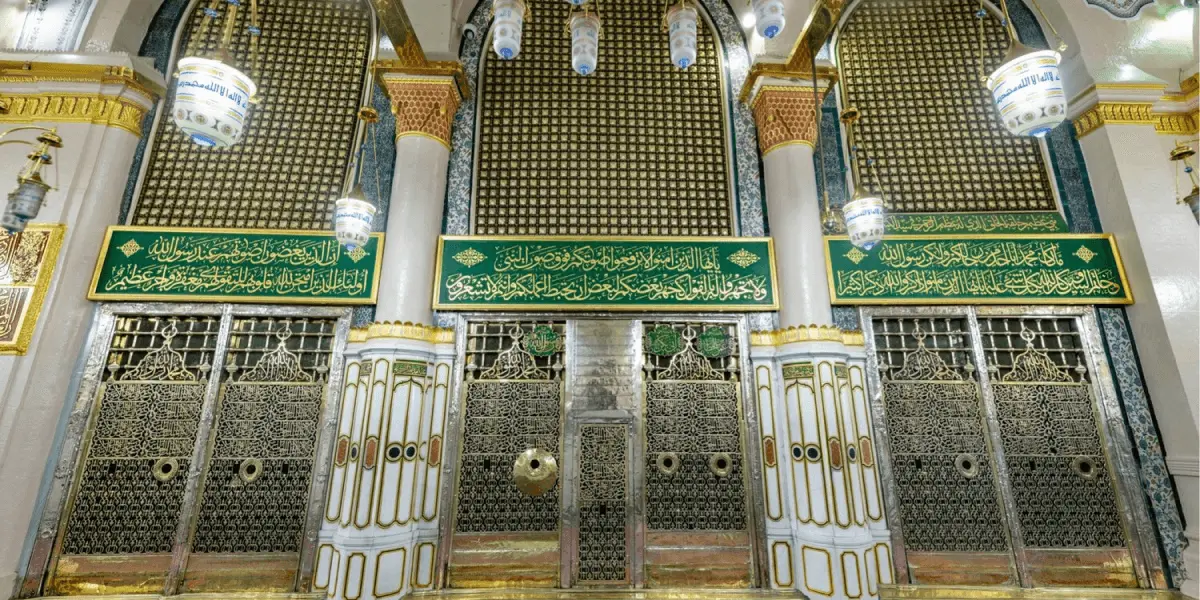
Ayat written on the Hujrat al-Nabi ﷺ:
﴿مَا كَانَ مُحَمَّدٌ أَبَا أَحَدٍ مِنْ رِجَالِكُمْ وَلَٰكِنْ رَسُولَ اللَّهِ وَخَاتَمَ النَّبِيِّينَ ۗ وَكَانَ اللَّهُ بِكُلِّ شَيْءٍ عَلِيمًا يَا أَيُّهَا الَّذِينَ آمَنُوا اذْكُرُوا اللَّهَ ذِكْرًا كَثِيرًا (سُورَةُ الأحزَاب ٣٣:٤٠)
33:40 Muhammad is not the father of ˹any˺ one of your men, but ˹he is˺ the Messenger of Allah and last of the prophets. And ever is Allah, of all things, Knowing.
﴿يَا أَيُّهَا الَّذِينَ آمَنُوا لَا تَرْفَعُوا أَصْوَاتَكُمْ فَوْقَ صَوْتِ النَّبِيِّ وَلَا تَجْهَرُوا لَهُ بِالْقَوْلِ كَجَهْرِ بَعْضِكُمْ لِبَعْضٍ أَنْ تَحْبَطَ أَعْمَالُكُمْ وَأَنْتُمْ لَا تَشْعُرُونَ ﴾ (سُورَةُ الحُجُرات ٤٩:٢)
49:2 O you who have believed, do not raise your voices above the voice of the Prophet or be loud to him in speech like the loudness of some of you to others, lest your deeds become worthless while you perceive not.
﴿إِنَّ الَّذِينَ يَغُضُّونَ أَصْوَاتَهُمْ عِنْدَ رَسُولِ اللَّهِ أُولَٰئِكَ الَّذِينَ امْتَحَنَ اللَّهُ قُلُوبَهُمْ لِلتَّقْوَىٰ ۚ لَهُمْ مَغْفِرَةٌ وَأَجْرٌ عَظِيمٌ ﴾ (سُورَةُ الحُجُرات ٤٩:٣)
49:3 Indeed, those who lower their voices before the Messenger of Allah - they are the ones whose hearts Allah has tested for righteousness. For them is forgiveness and great reward.
Blessed Birth of the Prophet ﷺ
- Tayran Ababil defended the birth of the Prophet ﷺ
- in the Am al-Fil
The Prophet ﷺ speaks about his own birth
(أنا) دَعْوَةُ أَبِي إِبْرَاهِيمَ، (أحمد ٢٢٢٦١)
˹I am˺ the dua of my father Ibrahim …
﴿رَبَّنَا وَابْعَثْ فِيهِمْ رَسُولًا مِنْهُمْ يَتْلُو عَلَيْهِمْ آيَاتِكَ وَيُعَلِّمُهُمُ الْكِتَابَ وَالْحِكْمَةَ وَيُزَكِّيهِمْ ۚ إِنَّكَ أَنْتَ الْعَزِيزُ الْحَكِيمُ ﴾ (سُورَةُ البَقَرَة ٢:١٢٩)
2:129 Our Lord, and send among them a messenger from themselves who will recite to them Your verses and teach them the Book and wisdom and purify them. Indeed, You are the Exalted in Might, the Wise."
وَبُشْرَى عِيسَى (أحمد ٢٢٢٦١)
… and the glad tidings of Jesus
﴿وَإِذْ قَالَ عِيسَى ابْنُ مَرْيَمَ يَا بَنِي إِسْرَائِيلَ إِنِّي رَسُولُ اللَّهِ إِلَيْكُمْ مُصَدِّقًا لِمَا بَيْنَ يَدَيَّ مِنَ التَّوْرَاةِ وَمُبَشِّرًا بِرَسُولٍ يَأْتِي مِنْ بَعْدِي اسْمُهُ أَحْمَدُ﴾ (سُورَةُ الصَّف ٦١:٦)
61:6 And ˹mention˺ when Jesus, the son of Mary, said, "O children of Israel, indeed I am the messenger of Allah to you confirming what came before me of the Torah and bringing good tidings of a messenger to come after me, whose name is Ahmad."
وَرَأَتْ أُمِّي أَنَّهُ يَخْرُجُ مِنْهَا نُورٌ أَضَاءَتْ مِنْهُ قُصُورُ الشَّامِ (أحمد ٢٢٢٦١)
... and my mother saw a light emanating from her that illuminated the palaces of Sham."
صَوْمِ يَوْمِ الاِثْنَيْنِ .. ذَاكَ يَوْمٌ وُلِدْتُ فِيهِ وَيَوْمٌ أُنْزِلَ عَلَىَّ فِيهِ (مسلم ١١٦٢b)»
He was then asked about fasting on Monday, whereupon he said: It was the day on which I was born. on which I was commissioned with prophethood or revelation was sent to me.
- Even Abu Lahab freed Thuwaybah
- Was named by his grandfather Abd al-Muttalib
Date of Birth of the Prophet ﷺ
Most famous: the Prophet was born on 12th of Rabi al-Awwal
قَالَ ابْنُ إسْحَاقَ: وُلِدَ رَسُولِ اللَّهِ ﷺ يَوْمَ الِاثْنَيْنِ[2] لِاثْنَتَيْ عَشْرَةَ لَيْلَةً خَلَتْ مِنْ شَهْرِ رَبِيعٍ الْأَوَّلِ، عَامَ الْفِيلِ
Ibn Ishaq (150 AH) said (without an chain), "the Messenger of Allah ﷺ was born on a Monday, on the night of the 12th of month of Rabi al-Awwal in the Year of the Elephant."
Strongest opinions
- by tabiun, tabi al-tabiun, and even the descendant of the Prophet
- 10th: Ibn Abbas (d. 68 AH), Jafar al-Sadiq (d. 148 AH), Ibn Sad (d. 230 AH), Ibn Asakir (d. 571 AH).
- 8th: Muhammad b. Jubayr b. Mutim (d. ~100 AH), al-Zuhri (d. 128 AH), Malik (d. 179 AH), Ibn Hazm (d. 456 AH)
- 2nd: Abu Mashar al-Sindhi (d. 171 AH), al-Waqidi (d. 207 AH), Ibn Abd al-Barr (d. 463 AH)
Other opinions
- 17th: Another opinion mentioned
- 22nd: Another opinion mentioned
- Ramadan: Opinion by al-Zubayr b. Bakkar (d. 256 AH)
- And other opinions
Moment He ﷺ was Appointed as a Prophet
At the time of the creation of Adam
«مَتَى كُتِبْتَ نَبِيًّا؟ قَالَ: «وآدَمُ بَيْنَ الرُّوحِ وَالْجَسَدِ»» (الترمذي ٣٦٠٩ صحيح)
They asked: 'O Messenger of Allah ﷺ! When was the Prophethood established for you?' He said: "While Adam was between (being) soul and body."
The Prophet ﷺ is the Best of Creation
Called Ibrahim was the best of all creation out of humility, although that was he himself
«قَالَ رَجُلٌ لِلنَّبِيِّ ﷺ: يَا خَيْرَ الْبَرِيَّةِ! قَالَ «ذَلِكَ إِبْرَاهِيمُ۔»» (الترمذي ٣٣٥٢ صحيح)
A man said to the Prophet ﷺ: O best of creation! So he said, “˹Not me,˺ that is Ibrahim.”
Type of Prophetic Studies
- Sirah (Biography)
- Dalail (Proofs of Prophethood)
- Fadail (Virtues and Qualities)
- Khasais (Specialties and Unique Characteristics)
- Shamail (Comprehensive Description)
- Description and features, character, speech, clothing, utensils, belongings, food, drink, likes, dislikes
Features of the Prophet ﷺ (Khalq)
General Appearance of the Prophet ﷺ
Hadith of Salam
«لَمَّا قَدِمَ رَسُولُ اللَّهِ ﷺ الْمَدِينَةَ اسْتَشْرَفَهُ النَّاسُ
فَخَرَجْتُ فِيمَنْ خَرَجَ فَلَمَّا رَأَيْتُ وَجْهَهُ عَرَفْتُ أَنَّ وَجْهَهُ لَيْسَ بِوَجْهِ كَذَّابٍ
فَكَانَ أَوَّلَ مَا سَمِعْتُهُ يَقُولُ: «يَا أَيُّهَا النَّاسُ (١) أَفْشُوا السَّلَامَ (٢) وَأَطْعِمُوا الطَّعَامَ (٣) وَصِلُوا الْأَرْحَامَ (٤) وَصَلُّوا (بالليل ) وَالنَّاسُ نِيَامٌ > تَدْخُلُوا الْجَنَّةَ بِسَلَامٍ» (الترمذي ٢٤٨٥ صحيح)
Abdullah b. Salam said: "When the Messenger of Allah ﷺ arrived in Madinah the people came out to meet him. It was said that the Messenger of Allah ﷺ had arrived, so I went among the people to get a look at him. When I gazed upon the face of the Messenger of Allah ﷺ, I knew that this face was not the face of a liar. The first thing that he spoke about was that he said: 'O you people! Spread the Salam, feed(others), and perform Salat while the people are sleeping; you will enter Paradise with (the greeting of) Salam.'"
Hadith: Amr b. al-As crying on his deathbed and describing his interactions the Prophet
«فَلَمَّا بَايَعْتُ رَسُولَ اللهِ ﷺ كُنْتُ أَشَدَّ النَّاسِ حَيَاءً مِنْهُ، فَمَا مَلَأْتُ عَيْنِي مِنْ رَسُولِ اللهِ ﷺ وَلَا رَاجَعْتُهُ فِيمَا أُرِيدُ حَتَّى لَحِقَ بِاللهِ ﷻ حَيَاءً مِنْهُ» (أحمد ١٧٧٨٠ صحيح)
When I pledged allegiance to the Messenger of Allah ﷺ , I was the most bashful of people before him. I could not gaze fully upon him, nor speak frankly with him until he departed to Allah out of shyness.
Blessed Stature of the Prophet ﷺ
The Messenger of Allah ﷺ was of medium stature
He was not excessively tall nor short
The Prophet ﷺ was of medium height, neither excessively tall nor short, striking a balance in his appearance.
Blessed Complexion of the Prophet ﷺ
He was neither extremely pale nor did he have dark skin
He had a wheatish complexion
أَزْهَرُ اللَّوْنِ[9]
He had a glowing complexion
His complexion was not extremely pale, nor was he dark. His blessed skin had a radiant hue, often described as luminous with a wheatish undertone. This glowing aspect of his skin added to his majestic presence.
Blessed Face and Countenance of the Prophet ﷺ
He neither had a large head nor a small head
He had roundness in his face
He had long eyes
كَانَتْ لَهُ مُكْحُلَةٌ يَكْتَحِلُ مِنْهَا كُلَّ لَيْلَةٍ ثَلَاثَةً فِي هَذِهِ، وَثَلَاثَةً فِي هَذِهِ[16]
He had a kohl container that he applied nightly thrice in each eye
He had jet black eyes and had long eyelashes
وَاسِعُ الْجَبِينِ[9:1]
He had a wide forehead
He had long arched eyebrows without being connected
Between his brows was a vein that throbbed when he was upset
أَقْنَى الْعِرْنَيْنِ[23]، لَهُ نُورٌ يَعْلُوهُ يَحْسَبُهُ مَنْ لَمْ يَتَأَمَّلْهُ أَشَمَّ[24] [9:4]
His nose was prominent that shone to make it seem like he had a elevated nose bridge
He had a wide mouth and with evenly spaced teeth
أَفْلَجَ الثَّنِيَّتَيْنِ[27]
He had a visible split between his front teeth
He had a thick beard and smooth cheekbones
He had a beautiful neckline as if it was shaped for a sliver statue
He face was radiant as the full moon radiates on the fortnight
The Prophet ﷺ’s face was slightly round, with radiant features that shone like the full moon. His eyes were jet black with long eyelashes, adding to their deep and captivating nature. His eyebrows were long and arched, without being connected, and a vein between his eyebrows would throb visibly when he was displeased. His nose was prominent, with a slight elevation that gave it a noble appearance. His mouth was wide, and his teeth were evenly spaced, and when he spoke, it appeared as if light emanated from between his teeth. His beard was thick, and his cheeks were smooth. His neck was likened to the clarity of silver, and his face radiated like the moon on a clear night.
Blessed Hair of the Prophet ﷺ
He neither had very curly hair nor he had straight hair
He had a slight wave in his hair
وَلَيْسَ فِي رَأْسِهِ وَلِحْيَتِهِ عِشْرُونَ شَعْرَةً بَيْضَاءَ[6:3]
He had no more than twenty white hair in his beard or hair in all
لَهُ شَعْرٌ يَضْرِبُ مَنْكِبَيْهِ[36]
His hair would touch his shoulders
He had hair that went down to his ear lobes in length
وَكَانَ لَهُ شَعْرٌ فَوْقَ الْجُمَّةِ وَدُونَ الْوَفْرَةِ[40]
His hair went down below his ears but not not short
إِنِ انْفَرَقَتْ عَقِيقَتُهُ فَرَّقَهَا، وَإِلَّا فَلَا يُجَاوِزُ شَعْرُهُ شَحْمَةَ أُذُنَيْهِ إِذَا هُوَ وَفَّرَهُ[41] [9:9]
If his hair could be parted, he would part them otherwise he would not part them
He would frequently oil his hair, comb his beard, and would often wear a head covering.
The Prophet ﷺ’s hair was slightly wavy, neither too curly nor completely straight. His hair would sometimes touch his shoulders, reaching his earlobes. His head and beard contained fewer than twenty white hairs even in his later years, and he took great care of his hair, often applying oil and combing it. He sometimes wore a cloth around his head, further signifying his dignified appearance.
Blessed Physique of the Prophet ﷺ
حَسَنَ الْجِسْمِ[4:2]
He had a handsome body
He had radiant and glowing skin.
He had broad shoulders.
شَثْنُ الْكَفَّيْنِ وَالْقَدَمَيْنِ[46]، ضَخْمُ الرَّأْسِ، ضَخْمُ الْكَرَادِيسِ،[47] طَوِيلُ الْمَسْرُبَةِ[48] [49]
He had sturdy palms and soles, proportionally large head and feet, and a fine line of hair extending from his chest to his navel.
He had sturdy fingers and toes and his joints were well-built.
He had long and sturdy forearms
مُعْتَدِلُ الْخَلْقِ، بَادِنٌ مُتَمَاسِكٌ،[54] سَوَاءُ الْبَطْنِ وَالصَّدْرِ، عَرِيضُ الصَّدْرِ [9:13]
His body was well-proportioned with his chest and stomach in line, and his chest was broad.
عَارِي الثَّدْيَيْنِ[55] وَالْبَطْنِ مِمَّا سِوَى ذَلِكَ، أَشْعَرُ الذِّرَاعَيْنِ وَالْمَنْكِبَيْنِ وَأَعَالِي الصَّدْرِ[56] [9:14]
His chest and abdomen were bare of excessive hair, but his arms, shoulders, and upper chest had hair.
مَسِيحُ الْقَدَمَيْنِ، يَنْبُو عَنْهُمَا الْمَاءُ[9:15]
The soles of his feet were smooth, and water would roll off them.
The flesh on his heels was light.
وَلاَ مَسِسْتُ خَزًّا قَطُّ وَلاَ حَرِيرًا وَلاَ شَيْئًا كَانَ أَلْيَنَ مِنْ كَفِّ رَسُولِ اللَّهِ ﷺ، وَلاَ شَمَمْتُ مِسْكًا قَطُّ وَلاَ عِطْرًا كَانَ أَطْيَبَ مِنْ عَرَقِ النَّبِيِّ ﷺ.»[58]
Anas b. Malik said: "I never touched silk or brocade softer than the palm of the Messenger of Allah ﷺ, and I never smelled musk or perfume more pleasant than the scent of the Prophet’s ﷺ sweat."
The Prophet ﷺ had a handsome, radiant body with broad shoulders and a well-proportioned, strong build. His hands and feet were thick and firm, his limbs long and well-formed, with a straight line of hair from his chest to his navel. His chest and stomach were level, his chest wide, and his upper body lightly covered with hair. His feet were smooth, and water would glide off them. His palms were softer than silk, and his sweat was more fragrant than the finest musk.
Umm Sulaym using sweat to perfume her perfume
«دَخَلَ عَلَيْنَا النَّبِيُّ ﷺ فَقَالَ عِنْدَنَا فَعَرِقَ وَجَاءَتْ أُمِّي بِقَارُورَةٍ فَجَعَلَتْ تَسْلُتُ الْعَرَقَ فِيهَا فَاسْتَيْقَظَ النَّبِيُّ ﷺ فَقَالَ يَا أُمَّ سُلَيْمٍ مَا هَذَا الَّذِي تَصْنَعِينَ قَالَتْ هَذَا عَرَقُكَ نَجْعَلُهُ فِي طِيبِنَا وَهُوَ مِنْ أَطْيَبِ الطِّيبِ» (مسلم ٢٣٣١a صحيح)
Anas b. Malik said: the Prophet ﷺ entered and stayed with us. He started to sweat. My mother came along with a container and started to collect his sweat. The Prophet ﷺ then woke up and asekd: "Umm Sulaim, what is this that you are doing?" Thereupon she said: That is your sweat which we mix in our perfume and it becomes the most fragrant perfume.
The Blessed Seal of Prophethood
بَيْنَ كَتِفَيْهِ خَاتَمُ النُّبُوَّةِ، وَهُوَ خَاتَمُ النَّبِيِّينَ[12:4]
Between his shoulders was the Seal of Prophethood, and he is the seal of the prophets.
"I looked at the seal between his shoulders, and it was like an egg of a partridge."
It was a raised, reddish flesh like the size of a pigeon’s egg.
Between his shoulders, the Prophet ﷺ bore the Seal of Prophethood, a mark that signified his status as the final prophet. This seal was described as a red, slightly raised piece of flesh, likened to the size of a pigeon’s egg.
Blessed Presence of the Prophet ﷺ
The Messenger of Allah ﷺ was dignified and made others feel awe.
When he walked, he leaned forward slightly, as if descending from a slope.
He walked with calm humility, taking long strides.
When he turned, he turned his whole body.
خَافِضُ الطَّرْفِ[68]، نَظَرُهُ إِلَى الْأَرْضِ أَطْوَلُ مِنْ نَظَرِهِ إِلَى السَّمَاءِ، جُلُّ نَظَرِهِ الْمُلَاحَظَةُ[69] [9:18]
He lowered his gaze; his glance toward the ground was longer than his glance toward the sky. Most of his looking was through observation, not staring.
He would walk behind his companions.
إِذَا مَشَى مَشَى أَصْحَابُهُ أَمَامَهُ وَتَرَكُوا ظَهْرَهُ لِلْمَلاَئِكَةِ
When the Prophet ﷺ walked, his companions would walk in front of him, leaving his back for the angels.
إِذَا أَشَارَ أَشَارَ بِكَفِّهِ كُلِّهَا[71]
When he gestured, he gestured with his entire hand.
وَكَانَ لَا يَضْحَكُ إِلَّا تَبَسُّمًا[72]
He did not laugh except with a smile.
مَا رَأَيْتُ أَحَدًا أَكْثَرَ تَبَسُّمًا مِنْ رَسُولِ اللَّهِ[73]
I never saw anyone smile more than the Messenger of Allah ﷺ.
كَانَ النَّبِيُّ ﷺ أَشدَّ حَيَاءً مِنَ الْعَذرَاءِ[74] فِي خِدْرِهَا، وَكَانَ إِذَا كَرِهَ شَيْئًا عَرَفْنَاهُ فِي وَجْهِهِ[75]
The Prophet ﷺ was more modest than a virgin in her chamber. If he disliked something, we would recognize it from his face.
The presence of the Prophet ﷺ was awe-inspiring and majestic. His manner of walking was unique, as he leaned slightly forward, walking as if descending from a slope, taking wide and deliberate steps. He would turn his entire body when he turned, a sign of his attentiveness and respect for others. His gaze was often lowered, and he would only glance upward when necessary. He was known for his modesty and shyness, more so than a veiled young woman. His laughter was mostly a smile, and he was known for his gentle and constant smile. His companions would often walk ahead of him, leaving his back for the angels, a testament to his esteemed and venerated presence.
Umm Mabad Describes the Prophet ﷺ
- An elderly bedouin woman, lived in a tent in the desert
- The Prophet ﷺ and Abu Bakr al-Siddiq visited her during Hijrah
- along with Amir b. Fuhayrah, Abdullah b. Urayqit
- Milked an old goat miraculously that produced milk
- She later realized who the visitors were when she told her husband about it
Her Description
مَرَّ بِنَا رَجُلٌ مُبَارَكٌ مِنْ حَالِهِ ۔۔۔ رَأَيْتُ رَجُلًا ظَاهِرَ الوَضَاءَةِ، أَبْلَجَ الوَجْهِ، حَسَنَ الخَلْقِ، لَمْ تَعِبْهُ نُحْلَةٌ، وَلَمْ تُزْرِ بِهِ صَعْلَةٌ، وَسِيمٌ قَسِيمٌ،[76]
A blessed man passed by us. ... I saw a man of radiant appearance, with a bright face, beautiful in form. Neither too thin nor deficient in physique. He was handsome and well-proportioned
فِي عَيْنَيْهِ دَعَجٌ، وَفِي أَشْفَارِهِ وَطَفٌ، وَفِي صَوْتِهِ صَحَلٌ، وَفِي عُنُقِهِ سَطَعٌ، وَفِي لِحْيَتِهِ كَثَاثَةٌ، أَزَجُّ أَقْرَنُ، إِنْ صَمَتَ فَعَلَيْهِ الوَقَارُ، وَإِنْ تَكَلَّمَ سَمَا وَعَلَاهُ البَهَاءُ،
With large dark eyes, long eyelashes, and a deep, slightly raspy voice. His neck was well-defined, and his beard was thick. His eyebrows were long and arched. When he remained silent, he was enveloped in dignity, but when he spoke, he was adorned with grace and majesty.
أَجْمَلُ النَّاسِ وَأَبْهَاهُم مِّنْ بَعِيدٍ، وَأَحْسَنُهُم وَأَحْلَاهُم مِّنْ قَرِيبٍ، حُلْوُ المَنْطِقِ، فَصْلٌ لَا نَزِرٌ وَلَا هَذِرٌ، كَأَنَّ مَنْطِقَهُ خَرَزَاتٌ نَظْمٌ يَتَحَدَّرْنَ،
From a distance, he was the most beautiful of people, and up close, he was the most pleasant and delightful. His speech was sweet, distinct, neither too brief nor excessive, as if his words were strung pearls flowing down.
لَا يَأْسَ مِنْ طُولٍ، وَلَا تَقْتَحِمُهُ عَيْنٌ مِنْ قِصَرٍ، كَغُصْنٍ بَيْنَ غُصْنَيْنِ، فَهُوَ أَنْضَرُ الثَّلَاثَةِ مَنْظَرًا، وَأَحْسَنُهُم قَدْرًا.
He was neither too tall to intimidate nor too short to be disregarded, but perfectly proportioned, like a branch between two other branches, the most striking and noble of the three.
لَهُ رُفَقَاءُ يَحُفُّونَ بِهِ، إِنْ قَالَ أَنْصَتُوا لِقَوْلِهِ، وَإِنْ أَمَرَ تَبَادَرُوا إِلَى أَمْرِهِ، مَحْفُودٌ مَحْشُودٌ، لَا عَابِسٌ، وَلَا مُفَنَّدٌ.
He was surrounded by companions who were attentive to him. When he spoke, they listened intently, and when he commanded, they hastened to fulfill his command. He was well-attended, always surrounded by people, yet never frowning nor disregarded.
Blessed Beauty of the Prophet ﷺ
عَلَيْهِ حُلَّةٌ حَمْرَاءُ، مَا رَأَيْتُ شَيْئًا قَطُّ أَحْسَنَ مِنْهُ[39:2]
al-Bara b. Azib said: "He was wearing a red cloak, and I never saw anything more beautiful than him."
al-Bara b. Azib said: "I never saw anyone with long hair in a red garment more beautiful than the Messenger of Allah ﷺ."
لَمْ أَرَ قَبْلَهُ وَلَا بَعْدَهُ مِثْلَهُ[49:1]
Many other companions said: "I never saw anyone like him before or after him."
The Prophet ﷺ looked better than the full moon
جَابِرِ بْنِ سَمُرَةَ: «رَأَيْتُ رَسُولَ اللَّهِ ﷺ فِي لَيْلَةٍ إِضْحِيَانٍ[78] فَجَعَلْتُ أَنْظُرُ إِلَى رَسُولِ اللَّهِ ﷺ وَإِلَى الْقَمَرِ وَعَلَيْهِ حُلَّةٌ حَمْرَاءُ فَإِذَا هُوَ عِنْدِي أَحْسَنُ مِنَ الْقَمَرِ» (الترمذي ٢٨١١ ضعيف)
Jabir b. Samurah said: "I saw the Prophet ﷺ on a clear night, so I looked at the Messenger of Allah ﷺ and at the moon, and he was wearing a red Hullah, and he looked better than the moon to me."
أنشودة: قَمَرٌ
وَأَجْمَلُ مِنْكَ لَمْ تَرَ قَطُّ عَيْني .. وَأَطْيَبُ مِنْكَ لَمْ تَلِدِ النِّسَاءُ ..
خُلِقْتَ مُبَرَّأً مِنْ كُلِّ عَيْبٍ .. كَأَنَّكَ قَدْ خُلِقْتَ كَمَا تَشَاءُ ..
–– [[حسّان بن ثابت]]
My eyes have never seen anyone more beautiful than you.
No woman has ever given birth to anyone more noble than you.
You were created free from all flaw—
As if you had been created just as you wished.
– Hassan b. Thabit
قَمَرٌ، سَيِّدُنَا النَّبِيّ، قَمَرٌ .. وَجَمِيلٌ، سَيِّدُنَا النَّبِيّ، وَجَمِيلٌ
وَكَفُّ الْمُصْطَفَى كَالْوَرْدِ نَادِي .. وَعِطْرُهَا يَبْقَى إِذَا مَسَّتْ أَيَادِي
. . وَعَمَّ نَوَالُهَا كُلَّ الْعِبَادِ .. حَبِيبُ اللَّهِ يَا خَيْرَ الْبَرَايَا .. قَمَرٌ
وَلَا ظِلٌّ لَهُ بَلْ كَانَ نُورَا .. تَنَالِ الشَّمْسَ مِنْهُ وَالْبُدُورَا
.. وَلَمْ يَكُنِ الْهُدَى لَوْلَا ظُهُورَا .. وَكُلُّ الْكَوْنِ أَنَارَ بِنُورِ طَه .. قَمَرٌ
A moon—our Master, the Prophet, is a radiant moon.
So beautiful—our Master, the Prophet, is so beautiful.
The hand of al-Mustafa is like a fresh rose,
Its fragrance lingers when touched by hands.
His generosity reached all of creation—
O Beloved of Allah, best of all beings, a radiant moon.
He cast no shadow, rather he was pure light.
The sun and full moons drew light from him.
There would have been no guidance without his appearance—
The entire cosmos lit up with the Nur of Ta-Ha. A radiant moon.
Blessed Speech of the Prophet ﷺ
دَائِمَ الْفِكْرَةِ لَيْسَتْ لَهُ رَاحَةٌ، طَوِيلُ السَّكْتِ، لَا يَتَكَلَّمُ فِي غَيْرِ حَاجَةٍ، يَفْتَتِحُ الْكَلَامَ وَيَخْتِمُهُ بِاسْمِ اللَّهِ تَعَالَى، وَيَتَكَلَّمُ بِجَوَامِعِ الْكَلِمِ، كَلَامُهُ فَصْلٌ[79]، لَا فُضُولَ[80] وَلَا تَقْصِيرَ، لَيْسَ بِالْجَافِي[81] وَلَا الْمُهِينِ[82] [71:1]
He was constantly deep in thought, never at rest, remained silent for long periods and did not speak without need. He began and ended his speech with the name of Allah. He spoke in concise, comprehensive words and his speech was clear and decisive—neither excessive nor lacking. He was never harsh nor insulting.
إِذَا تَكَلَّمَ رُئِيَ كَالنُّورِ يَخْرُجُ مِنْ بَيْنِ ثَنَايَاهُ[27:1]
When he spoke, it appeared as if light was coming out from between his teeth.
Blessed Character of the Prophet ﷺ (Khuluq)
﴿وَإِنَّكَ لَعَلَىٰ خُلُقٍ عَظِيمٍ ﴾ (سُورَةُ القَلَم ٦٨:٤)
68:4 And indeed, you are of a great moral character.
كَانَ خُلُقُهُ الْقُرْآنَ
His character was the Quran.
أَجْوَدُ النَّاسِ صَدْرًا، وَأَصْدَقُ النَّاسِ لَهْجَةً،[12:6]
He had the most generous heart of people and was the most truthful in speech.
وَأَلْيَنُهُمْ عَرِيكَةً[83]، وَأَكْرَمُهُمْ عِشْرَةً[84]، مَنْ رَآهُ بَدِيهَةً[85] هَابَهُ[86]، وَمَنْ خَالَطَهُ مَعْرِفَةً أَحَبَّهُ[12:7]
He was the gentlest in nature, most temperament and tolerant, and the most noble in companionship. Whoever saw him unexpectedly was filled with awe of him, and whoever interacted with him closely came to love him.
وَيَبْدَأُ مَنْ لَقِيَ بِالسَّلَامِ[9:20]
He was the first to greet those he met with peace.
يُعَظِّمُ النِّعْمَةَ[71:2]
He highly valued every blessing.
وَلَا تُغْضِبُهُ الدُّنْيَا، وَلَا مَا كَانَ لَهَا، فَإِذَا تُعُدِّيَ الْحَقُّ لَمْ يَقُمْ لِغَضَبِهِ شَيْءٌ حَتَّى يَنْتَصِرَ لَهُ، وَلَا يَغْضَبُ لِنَفْسِهِ، وَلَا يَنْتَصِرُ لَهَا[71:3]
The worldly life and what pertained to it never angered him, but when the truth was violated, nothing could stand in the way of his anger until justice was upheld. He never became angry for himself, nor sought revenge for personal reasons.
مَا سُئِلَ رَسُولُ اللَّهِ ﷺ شَيْئًا قَطُّ فَقَالَ: لَا[87]
The Messenger of Allah ﷺ was never asked for something and replied “no.”
كَانَ رَسُولُ اللَّهِ ﷺ أَجْوَدَ بِالْخَيْرِ مِنَ الرِّيحِ الْمُرْسَلَةِ[88]
The Messenger of Allah ﷺ was more generous in doing good than the freely-blowing wind.
لَمْ يَكُنْ رَسُولُ اللَّهِ ﷺ فَاحِشًا وَلَا مُتَفَحِّشًا[89] ... وَلَا يَجْزِىءُ بِالسَّيِّئَةِ السَّيِّئَةَ، وَلَكِنْ يَعْفُو وَيَصْفَحُ[90]
The Messenger of Allah ﷺ was neither obscene nor vulgar, and he never repaid evil with evil but would pardon and forgive.
أنس: خَدَمْتُ النَّبِيَّ ﷺ عَشْرَ سِنِينَ. فَمَا قَالَ لِي أُفٍّ قَطُّ، وَمَا قَالَ لِشَيْءٍ صَنَعْتُهُ: لِمَ صَنَعْتَهُ؟ وَلاَ لِشَيْءٍ تَرَكْتُهُ: لِمَ تَرَكْتَهُ؟ وَكَانَ رَسُولُ اللَّهِ ﷺ مِنْ أَحْسَنِ النَّاسِ خُلُقًا
Anas b. Malik said: "I served the Prophet ﷺ for ten years. Not once did he say to me “Uff,” nor did he ever say about something I did, “Why did you do it?” nor about something I left, “Why didn’t you do it?” The Messenger of Allah ﷺ had the best character of all people."
عائشة: مَا ضَرَبَ رَسُولُ اللَّهِ ﷺ بِيَدِهِ شَيْئًا قَطُّ إِلَا أَنْ يُجَاهِدَ فِي سَبِيلِ اللَّهِ، وَلَا ضَرَبَ خَادِمًا أَوِ امْرَأَةً[91]
Aishah said: "The Messenger of Allah ﷺ never struck anything with his hand—except when fighting in the path of Allah—and he never struck a servant nor a woman."
The Prophet ﷺ was the embodiment of the Quran, marked by deep thought, measured speech, and unmatched generosity. He was gentle, noble in companionship, and deeply loved by those who knew him. He never acted out of personal anger, never said “no” when asked, and never repaid wrong with wrong. He valued every blessing, began interactions with peace, and treated others with kindness and patience. His speech was wise and concise, his presence inspiring awe, and his mercy encompassed all. He never struck a servant or woman, and those who served him testified to his perfect character and unmatched compassion.
Khadija ᴿᴬ description of the Prophet ﷺ before Prophethood
«فَرَجَعَ بِهَا رَسُولُ اللَّهِ ﷺ يَرْجُفُ فُؤَادُهُ، فَدَخَلَ عَلَى خَدِيجَةَ بِنْتِ خُوَيْلِدٍ ؓ فَقَالَ: «زَمِّلُونِي، زَمِّلُونِي۔» فَزَمَّلُوهُ حَتَّى ذَهَبَ عَنْهُ الرَّوْعُ۔ فَقَالَ لِخَدِيجَةَ وَأَخْبَرَهَا الْخَبَرَ: «لَقَدْ خَشِيتُ عَلَى نَفْسِي۔» فَقَالَتْ خَدِيجَةُ: «كَلاَّ! وَاللَّهِ مَا يُخْزِيكَ اللَّهُ أَبَدًا! إِنَّكَ (١) لَتَصِلُ الرَّحِمَ، (٢) وَتَحْمِلُ الْكَلَّ، (٣) وَتَكْسِبُ الْمَعْدُومَ، (٤) وَتَقْرِي الضَّيْفَ، (٥) وَتُعِينُ عَلَى نَوَائِبِ الْحَقِّ۔» (البخاري ٣ متفق عليه)
… the Messenger of Allah ﷺ then returned with the Inspiration and with his heart beating severely. Then he went to Khadijah b. Khuwaylid ᴿᴬ and said, "Cover me! Cover me!" They covered him till his fear was lifted and after that he told her what had happened and said, "I fear for myself." Khadijah said, "Never! By Allah, Allah will never disgrace you! (1) In fact, you keep good relations with your kith and kin, (2) you carry the weak, (3) you provide for those deprived, (4) you are hospitable to your guests, and (5) you assist the deserving ˹calamity-afflicted˺ ones."
Summary of His Blessed Character
- Forbearing, patient, just, honest and chaste
- Never touched women, bashful and shy, did not stare
- Most generous – gave excess by end of day
- He ate whatever was available, one date, dry bread or barley, sweets and honey,
- Wore stones around his waist
- Wore what was available
- Gave whenever asked
- Favored without any selfish motive
- Accepted any gifts
- Spoke gently to the poor
- Visited the sick, attended funerals
- Walked alone without a guard
- Did not tyrannize or was harsh
- Forgave who asked pardon
- Never cursed, never struck anyone
- Taught us to make dua for people
- Chose easiest of two options
- Slept anywhere or reclined
- Invoked Allah on every action
- Sat in the last row
- Listened, did not interrupt, graceful
- Honored his companions
- Did not speak without need
- Smiled with teeth, joked
- Prayed anywhere
- Kind to family
- Did not hit any one
- Never vengeful
- Did not like people standing for him
- Bed was leather with data palms and canvas with date palms
- Prayed all night to be grateful
The Prophet ﷺ was patient, just, honest, and chaste—marked by deep humility and modesty. He never touched women outside permissible bounds, avoided staring, and treated all with gentleness and dignity. He gave generously, often ending his day with nothing left, accepting gifts and giving without selfish motive. He ate whatever was available, wore what he had, and sometimes tied stones to his stomach out of hunger. He spoke kindly to the poor, visited the sick, attended funerals, and walked alone without a guard. He forgave those who sought pardon, never cursed or struck anyone, and was never vengeful. He taught us to pray for others, chose the easier option when lawful, and invoked Allah ﷻ in all actions. He sat in the last row, listened attentively, honored his companions, and never spoke unnecessarily. He smiled, made light jokes, prayed anywhere, and showed deep love for his family. He disliked people standing for him and lived simply, sleeping on a bed of palm fibers. Even after all his hardships, he prayed through the night out of gratitude to Allah.
The best example
﴿لَقَدْ كَانَ لَكُمْ فِي رَسُولِ اللَّهِ أُسْوَةٌ حَسَنَةٌ لِمَنْ كَانَ يَرْجُو اللَّهَ وَالْيَوْمَ الْآخِرَ وَذَكَرَ اللَّهَ كَثِيرًا ﴾ (سُورَةُ الأحزَاب ٣٣:٢١)
33:21 There has certainly been for you in the Messenger of Allah an excellent pattern for anyone whose hope is in Allah and the Last Day and ˹who˺ remembers Allah often.
Blessed Sustenance of the Prophet ﷺ
مَا شَبِعَ آلُ مُحَمَّدٍ ﷺ مُنْذُ قَدِمَ الْمَدِينَةَ مِنْ طَعَامِ الْبُرِّ[92] ثَلاَثَ لَيَالٍ تِبَاعًا حَتَّى قُبِضَإِنْ كُنَّا لَنَنْظُرُ إِلَى الْهِلاَلِ ثُمَّ الْهِلاَلِ ثَلاَثَةَ أَهِلَّةٍ فِي شَهْرَيْنِ وَمَا أُوقِدَتْ فِي أَبْيَاتِ رَسُولِ اللَّهِ ﷺ نَارٌ، فَقُلْتُ يَا خَالَةُ مَا كَانَ يُعِيشُكُمْ قَالَتِ الأَسْوَدَانِ التَّمْرُ وَالْمَاءُ
The Prophet ﷺ lived a simple life, subsisting on modest provisions. His household rarely ate bread for three consecutive days, and they sometimes survived on dates and water for long periods. He taught moderation in food, instructing his followers that a person should only eat enough to support their body.
One should eat only what is sufficient for his well-being
«سَمِعْتُ رَسُولَ اللَّهِ ﷺ يَقُولُ: «مَا مَلأَ آدَمِيٌّ وِعَاءً شَرًّا مِنْ بَطْنٍ: بِحَسْبِ ابْنِ آدَمَ أُكُلاَتٌ يُقِمْنَ صُلْبَهُ؛ فَإِنْ كَانَ لاَ مَحَالَةَ، فَثُلُثٌ لِطَعَامِهِ، وَثُلُثٌ لِشَرَابِهِ، وَثُلُثٌ لِنَفَسِهِ۔»» (الترمذي ٢٣٨٠ صحيح)
I heard the Messenger of Allah ﷺ saying, "The human being does not fill any vessel that is worse than his stomach. It is sufficient for the son of Adam to eat what will support his back. If this is not possible, then a third for food, a third for drink, and third for his breath."
Tireless Worship of the Prophet ﷺ
- Constant dhikr and istighfar
- Prayed on his ride, even when traveling
- Fasted often
The best voluntary salah is the salah prayed at home
«قَدْ عَرَفْتُ الَّذِي رَأَيْتُ مِنْ صَنِيعِكُمْ فَصَلُّوا أَيُّهَا النَّاسُ فِي بُيُوتِكُمْ فَإِنَّ أَفْضَلَ الصَّلاَةِ صَلاَةُ الْمَرْءِ فِي بَيْتِهِ إِلاَّ الْمَكْتُوبَةَ» (البخاري ٧٣١ متفق عليه)
Messenger of Allah ﷺ made a small room in the month of Ramadan (Said said, "I think that Zaid bin Thabit said that it was made of a mat") and he prayed there for a few nights, and so some of his companions prayed behind him. When he came to know about it, he kept on sitting. In the morning, he went out to them and said, "I have seen and understood what you did. You should pray in your houses, for the best prayer of a person is that which he prays in his house except the compulsory prayers."
The Prophet ﷺ showed gratitude praying the night until his feet swelled
«كَانَ رَسُولُ اللَّهِ ﷺ إِذَا صَلَّى قَامَ حَتَّى تَفَطَّرَ رِجْلاَهُ قَالَتْ عَائِشَةُ: يَا رَسُولَ اللَّهِ أَتَصْنَعُ هَذَا وَقَدْ غُفِرَ لَكَ مَا تَقَدَّمَ مِنْ ذَنْبِكَ وَمَا تَأَخَّرَ؟ فَقَالَ: «يَا عَائِشَةُ أَفَلاَ أَكُونُ عَبْدًا شَكُورًا؟»» (مسلم ٢٨٢٠ صحيح)
The Messenger of Allah ﷺ used to stand up after performing prayer until his feet were swollen. Aishah said, "O Messenger of Allah, do you do this while your past and future sins have been forgiven?" He replied, "O Aishah, should I not be a grateful servant?"
Concern of the Prophet ﷺ for His Ummah
Allah describes this concern
﴿لَقَدْ جَاءَكُمْ رَسُولٌ مِنْ أَنْفُسِكُمْ عَزِيزٌ عَلَيْهِ مَا عَنِتُّمْ[93] حَرِيصٌ[94] عَلَيْكُمْ بِالْمُؤْمِنِينَ رَءُوفٌ رَحِيمٌ ﴾ (سُورَةُ التوبَة ٩:١٢٨)
9:128 There has certainly come to you a Messenger from among yourselves. Grievous to him is what you suffer; ˹he is˺ concerned over you and to the believers is kind and merciful.
Allah will not punish them if you are among them
﴿وَمَا كَانَ اللَّهُ لِيُعَذِّبَهُمْ وَأَنْتَ فِيهِمْ ۚ وَمَا كَانَ اللَّهُ مُعَذِّبَهُمْ وَهُمْ يَسْتَغْفِرُونَ ﴾ (سُورَةُ الأنفَال ٨:٣٣)
8:33 But Allah would not punish them while you, ˹O Muhammad˺, are among them, and Allah would not punish them while they seek forgiveness.
His dua during an eclipse
«انْكَسَفَتِ الشَّمْسُ عَلَى عَهْدِ رَسُولِ اللَّهِ ﷺ … فَجَعَلَ يَتَضَرَّعُ وَيَبْكِي وَيَقُولُ «رَبِّ أَلَمْ تَعِدْنِي أَنْ لَا تُعَذِّبَهُمْ وَأَنَا فِيهِمْ أَلَمْ تَعِدْنِي أَنْ لَا تُعَذِّبَهُمْ وَنَحْنُ نَسْتَغْفِرُكَ» (ابن حبّان ٢٨٣٨ صحيح لغيره)
The sun was eclipsed during the time of the Messenger of Allah ﷺ .. He began to supplicate, cry, and say, "O Lord, did You not promise me not to punish them while I am among them? Did You not promise me not to punish them while we seek Your forgiveness?"
The Prophet ﷺ concern and dua for his Ummah
«… فَرَفَعَ يَدَيْهِ وَقَالَ «اللَّهُمَّ أُمَّتِي أُمَّتِي» وَبَكَى
فَقَالَ اللَّهُ ﷻ: (فَقَالَ اللَّهُ يَا جِبْرِيلُ اذْهَبْ إِلَى مُحَمَّدٍ فَقُلْ إِنَّا سَنُرْضِيكَ فِي أُمَّتِكَ وَلاَ نَسُوءُكَ» (مسلم ٢٠٢ صحيح)
Then he raised his hands and said: O Lord, my Ummah, my Ummah, and wept … Upon this Allah said: O Jibril, go to Muhammad and say: Verily We will please thee with regard to your Ummah and would not displease thee.
His ﷺ Behavior With His Companions
Allah commands to show mercy to them
﴿فَبِمَا رَحْمَةٍ مِنَ اللَّهِ لِنْتَ لَهُمْ ۖ وَلَوْ كُنْتَ فَظًّا غَلِيظَ الْقَلْبِ لَانْفَضُّوا مِنْ حَوْلِكَ ۖ فَاعْفُ عَنْهُمْ وَاسْتَغْفِرْ لَهُمْ وَشَاوِرْهُمْ فِي الْأَمْرِ ۖ فَإِذَا عَزَمْتَ فَتَوَكَّلْ عَلَى اللَّهِ ۚ إِنَّ اللَّهَ يُحِبُّ الْمُتَوَكِّلِينَ ﴾ (سُورَةُ آل عِمرَان ٣:١٥٩)
3:159 So by mercy from Allah, ˹O Muhammad˺, you were lenient with them. And if you had been rude ˹in speech˺ and harsh in heart, they would have disbanded from about you. So pardon them and ask forgiveness for them and consult them in the matter. And when you have decided, then rely upon Allah. Indeed, Allah loves those who rely ˹upon Him˺.
Behavior of Companions of the Prophet ﷺ
What Urwah b. Masud said to the Quraysh during negotiations at Hudaybiyyah (Bukhari and Ibn Hisham)
يَا قَوْمِ! وَاللَّهِ لَقَدْ وَفَدْتُ عَلَى الْمُلُوكِ وَالرُّؤَسَاءِ، وَفَدْتُ عَلَى كِسْرَى، وَقَيْصَرَ، وَالنَّجَاشِيِّ، وَإِنِّي وَاللَّهِ مَا رَأَيْتُ مَلِكًا فِي قَوْمٍ قَطُّ مِثْلَ مُحَمَّدٍ فِي أَصْحَابِهِ …[95]
O people! By Allah, I have visited kings and leaders. I have visited Kisra, Caesar, and the Negus. But by Allah, I have never seen a king among his people like Muhammad among his companions…
وَوَاللَّهِ مَا رَأَيْتُ أَحَدًا يُعَظِّمُهُ أَصْحَابُهُ كَمَا رَأَيْتُ أَصْحَابَ مُحَمَّدٍ يُعَظِّمُونَ مُحَمَّدًا ﷺ:
By Allah, I have not seen anyone revered by his companions as much as Muhammad ﷺ is revered by his companions:
لَا يَتَوَضَّأُ إِلَّا ابْتَدَرُوا وُضُوءَهُ، وَلَا يَبْصُقُ بُصَاقًا إِلَّا ابْتَدَرُوهُ
He would not perform ablution except that they rushed to obtain its water, and he did not spit except that they would hasten to catch it.
وَلَا تَوَضَّأَ حَتَّى كَادُوا يَقْتَتِلُونَ عَلَى وُضُوئِهِ، وَإِذَا أَمَرَهُمْ ابْتَدَرُوا أَمْرَهُ، وَإِذَا تَكَلَّمَ خَفَضُوا الصَّوْتَ عِنْدَهُ، وَمَا يُحِدُّونَ إِلَيْهِ النَّظَرَ تَعْظِيمًا لَهُ [96]
He would not perform ablution without them nearly fighting over it, and when he commanded them, they rushed to obey. When he spoke, they lowered their voices in his presence, and none of them would look directly at him out of reverence.
فَوَاللَّهِ مَا تَنَخَّمَ مُحَمَّدٌ نُخَامَةً إِلَّا وَقَعَتْ فِي كَفِّ رَجُلٍ مِنْهُمْ؛ فَدَلَّكَ بِهَا وَجْهَهُ وَجِلْدَهُ [96:1]
By Allah, Muhammad did not spit except that it fell into the hand of one of them, who would then rub it on his face and skin
نعت: تاجدارِ حرم
يا مُصْطَفَى، يا مُجْتَبَى …
بَدْرُ الدُّجَى، شَمْسُ الضُّحَى
مَنْ وَجْهُهُ شَمْسُ الضُّحَى .. مَنْ خَدُّهُ بَدْرُ الدُّجَى
.. مَن ذآتُهُ، نُورُ الهُدَى .. مَنْ كَفُّهُ بَحْرُ الْهَمَمْ
.. اِذْ جَاءَنَا أحْكَامُهُ .. كُلُّ الصُّحُفِ صَارَ الْعَدَمْ
اِنْ نَلْتِ يَا رِيْحَ الصَّبَا .. يَوْمًا إلَي أَرْضِ الحَرمْ
بَلِّغْ سَلاَمِي رَوْضَةً .. فِيْهَا النَّبِيُّ المُحْتَرَم
تاجدارِ حرم، ہو نگاہ کرم
.. ہم غریبوں کے دن بھی سنور جائیں گے
یاد رکھو اگر، اٹھ گئی اک نظر
.. جتنے خالی ہیں سب جام بھر جائیں گے
تاجدارِ حرم
O Chosen One, O Elect One…
The full moon of the dark night, the sun of the morning light.
His face is like the shining sun,
His cheeks are like the full moon of night.
His essence is the light of guidance,
His hand is an ocean of generosity and courage.
When his orders came to us,
All other scriptures faded into nothingness.
O breeze of the morning!
If one day you reach the sacred land,
Deliver my salam to the Rawdah
Where the noble Prophet rests.
O Crown-Bearer of the Haram, cast upon us a glance of mercy
Even we, the poor and lowly, will see our days transformed.
Remember: if even one glance is raised in our direction,
Then every empty cup will overflow.
O Crown-Bearer of the Haram!
Passing Away of the Prophet ﷺ
آخِرُ نَظْرَةٍ نَظَرْتُهَا إِلَى رَسُولِ اللَّهِ ﷺ كَشْفُ السِّتَارَةِ يَوْمَ الْإِثْنَيْنِ، فَنَظَرْتُ إِلَى وَجْهِهِ كَأَنَّهُ وَرَقَةُ مُصْحَفٍ... ثُمَّ تَبَسَّمَ رَسُولُ اللَّهِ ﷺ ضَاحِكًا[97]
The last time I looked at the Messenger of Allah ﷺ was when the curtain was lifted on Monday, and I looked at his face—it was as bright as a page from the Quran. Then the Messenger of Allah ﷺ smiled joyfully.
أَنَّ أَبَا بَكْرٍ، دَخَلَ عَلَى النَّبِيِّ ﷺ بَعْدَ وَفَاتِهِ فَوَضَعَ فَمَهُ بَيْنَ عَيْنَيْهِ وَوَضَعَ يَدَيْهِ عَلَى سَاعِدَيْهِ، وَقَالَ: وَانَبِيَّاهُ، وَاصَفِيَّاهُ، وَاخَلِيلَاهُ
Abu Bakr entered upon the Prophet ﷺ after his death, placed his lips between his eyes, placed his hands on his forearms, and said: “O my Prophet, O my chosen one, O my beloved friend.”
قُبِضَ رَسُولُ اللهِ ﷺ وَمَا شَبِعَ مِنْ الأَسْوَدَيْنِ: التَّمْرِ وَالمَاءِ
The Messenger of Allah ﷺ passed away and had never filled his stomach with the two black things: dates and water.
أَخْرَجَتْ إِلَيْنَا عَائِشَةُ كِسَاءً مُبَلَّدًا[98] وَإِزَارًا غَلِيظًا فَقَالَتْ «قُبِضَ رَسُولُ اللَّهِ ﷺ فِي هَذَيْنِ»
Aishah brought out for us a coarse cloak and a rough lower garment and said, “The Messenger of Allah ﷺ passed away wearing these two.”
لَمَّا كَانَ الْيَوْمُ الَّذِي دَخَلَ فِيهِ رَسُولُ اللَّهِ ﷺ الْمَدِينَةَ أَضَاءَ مِنْهَا كُلُّ شَيْءٍ، فَلَمَّا كَانَ الْيَوْمُ الَّذِي مَاتَ فِيهِ أَظْلَمَ مِنْهَا كُلُّ شَيْءٍ[99]
When the day came that the Messenger of Allah ﷺ entered Madinah, everything in it became illuminated. But on the day he passed away, everything in it turned dark.
Umm Ayman crying due to the loss of the direct Divine connection after the death of the Prophet ﷺ
«لَمَّا قُبِضَ رَسُولُ اللهِ ﷺ بَكَتْ أُمُّ أَيْمَنَ وَهِيَ أُمُّ أُسَامَةَ بْنِ زَيْدٍ فَقِيلَ لَهَا مَا يُبْكِيكَ؟ فَقَالَتْ «انْقَطَعَ عَنَّا خَبَرُ السَّمَاءِ»» (الطبراني ٢١٧٨٨ لا نعرف حكم له)
When the Messenger of Allah ﷺ passed away, Umm Ayman, who was the mother of Usama b. Zayd, cried. It was asked, "What makes you cry?" She replied, "The news from heaven has been cut off from us."
The Intercession of the Prophet ﷺ (Shafaah)
The dua he saved for his Ummah
«لِكُلِّ نَبِيٍّ دَعْوَةٌ دَعَاهَا لأُمَّتِهِ وَإِنِّي اخْتَبَأْتُ دَعْوَتِي شَفَاعَةً لأُمَّتِي يَوْمَ الْقِيَامَةِ» (مسلم ٢٠٠a صحيح)
Verily the Messenger of Allah ﷺ said: There is for every apostle a prayer with which he prays (to Allah) for his Ummah. I have reserved my prayer for the intercession of my Ummah on the Day of Resurrection.
His elevation on the Day of Judgement when he lowered himself
﴿وَمِنَ اللَّيْلِ فَتَهَجَّدْ بِهِ نَافِلَةً لَكَ عَسَىٰ أَنْ يَبْعَثَكَ رَبُّكَ مَقَامًا مَحْمُودًا ﴾ (سُورَةُ الإسْرَاء ١٧:٧٩)
17:79 And from ˹part of˺ the night, pray with it as additional ˹worship˺ for you; it is expected that your Lord will resurrect you to a praised station.
Hadith Shafaah: The scene where people out of severe distress will be seeking intercession of the Prophets; Intercession of the Prophet Muhammad ﷺ will be granted
«...فَيَأْتُونَ آدَمَ .. نُوحًا ..إِبْرَاهِيمَ .. مُوسَى .. عِيسَى ..
فَيَأْتُونَ مُحَمَّدًا ﷺ فَيَقُولُونَ: يَا مُحَمَّدُ، أَنْتَ رَسُولُ اللَّهِ وَخَاتَمُ الأَنْبِيَاءِ وَقَدْ غَفَرَ اللَّهُ لَكَ مَا تَقَدَّمَ مِنْ ذَنْبِكَ وَمَا تَأَخَّرَ۔ اشْفَعْ لَنَا إِلَى رَبِّكَ۔ أَلاَ تَرَى إِلَى مَا نَحْنُ فِيهِ؟
فَأَنْطَلِقُ، فَآتِي تَحْتَ الْعَرْشِ، فَأَقَعُ سَاجِدًا لِرَبِّي ﷻ۔ ثُمَّ يَفْتَحُ اللَّهُ عَلَىَّ مِنْ مَحَامِدِهِ وَحُسْنِ الثَّنَاءِ عَلَيْهِ شَيْئًا لَمْ يَفْتَحْهُ عَلَى أَحَدٍ قَبْلِي۔
ثُمَّ يُقَالُ: يَا مُحَمَّدُ، ارْفَعْ رَأْسَكَ! سَلْ تُعْطَهْ! وَاشْفَعْ تُشَفَّعْ!
فَأَرْفَعُ رَأْسِي فَأَقُولُ: أُمَّتِي يَا رَبِّ! أُمَّتِي يَا رَبِّ! فَيُقَالُ: يَا مُحَمَّدُ أَدْخِلْ مِنْ أُمَّتِكَ مَنْ لاَ حِسَابَ عَلَيْهِمْ مِنَ الْبَابِ الأَيْمَنِ مِنْ أَبْوَابِ الْجَنَّةِ، وَهُمْ شُرَكَاءُ النَّاسِ فِيمَا سِوَى ذَلِكَ مِنَ الأَبْوَابِ،» (البخاري ٤٧١٢ متفق عليه)
So they will go to Adam … then Noah… then Ibrahim… then Musa…, then Jesus… So they will come to me and say, 'O Muhammad ! You are Messenger of Allah ﷺ and the last of the prophets, and Allah forgave your early and late sins. (Please) intercede for us with your Lord. Don't you see in what state we are?" The Prophet ﷺ added, "Then I will go beneath Allah's Throne and fall in prostration before my Lord. And then Allah will guide me to such praises and glorification to Him as He has never guided anybody else before me. Then it will be said, 'O Muhammad Raise your head. Ask, and it will be granted. Intercede and It (your intercession) will be accepted.' So I will raise my head and Say, 'My followers, O my Lord! My followers, O my Lord'. It will be said, 'O Muhammad! Let those of your followers who have no accounts, enter through such a gate of the gates of Paradise as lies on the right; and they will share the other gates with the people."
Hadith of My Brothers (Ikhwani)
The Prophet ﷺ is longing to meet his brothers; Hadith Ikhwani
«وَدِدْتُ أَنَّا قَدْ رَأَيْنَا إِخْوَانَنَا۔»
قَالُوا: أَوَلَسْنَا إِخْوَانَكَ يَا رَسُولَ اللَّهِ؟ قَالَ: «أَنْتُمْ أَصْحَابِي وَإِخْوَانُنَا الَّذِينَ لَمْ يَأْتُوا بَعْدُ (الَّذِينَ آمَنُوا بِي وَلَمْ يَرَوْنِي)۔»
فَقَالُوا: كَيْفَ تَعْرِفُ مَنْ لَمْ يَأْتِ بَعْدُ مِنْ أُمَّتِكَ يَا رَسُولَ اللَّهِ؟ …
فَقَالَ: «فَإِنَّهُمْ يَأْتُونَ غُرًّا مُحَجَّلِينَ مِنَ الْوُضُوءِ، وَأَنَا فَرَطُهُمْ عَلَى الْحَوْضِ۔»» (مسلم ٢٤٩a صحيح)
"I love to see my brothers." They (the companions) said: Aren't we your brothers, O Messenger of Allah? He said: You are my companions, and our brothers are those who have, so far, not come into the world ˹those who believe in me but have not seen me˺. They said: Messenger of Allah, how would you recognise those persons of your Ummah who have not yet been born? … They would come with white faces and arms and legs owing to ablution, and I would arrive at the Cistern before them.
Dreaming of the Prophet ﷺ
Those would would love to catch a glimpse
«مِنْ أَشَدِّ أُمَّتِي لِي حُبًّا نَاسٌ يَكُونُونَ بَعْدِي يَوَدُّ أَحَدُهُمْ لَوْ رَآنِي بِأَهْلِهِ وَمَالِهِ» (مسلم ٢٨٣٢ صحيح)
The people most loved by me from amongst my Ummah would be those who would come after me but everyone amongst them would have the keenest desire to catch a glimpse of me even at the cost of his family and wealth.
Dreaming about the Prophet ﷺ
«مَنْ رَآنِي فِي الْمَنَامِ فَقَدْ رَآنِي فَإِنَّ الشَّيْطَانَ لاَ يَتَمَثَّلُ بِي» (مسلم ٢٢٦٦a صحيح)
He who saw me in a dream in fact saw me, for the satan does not appear in my form.
What Should We Do?
Love the Prophet ﷺ
Love for the Prophet
«لاَ يُؤْمِنُ أَحَدُكُمْ حَتَّى أَكُونَ أَحَبَّ إِلَيْهِ مِنْ وَالِدِهِ وَوَلَدِهِ وَالنَّاسِ أَجْمَعِينَ۔» (البخاري ١٥ متفق عليه)
"None of you will have faith till he loves me more than his father, his children and all mankind."
You will be with the ones you love
«جَاءَ رَجُلٌ إِلَى رَسُولِ اللَّهِ ﷺ فَقَالَ يَا رَسُولَ اللَّهِ مَتَى السَّاعَةُ قَالَ وَمَا أَعْدَدْتَ لِلسَّاعَةِ قَالَ حُبَّ اللَّهِ وَرَسُولِهِ قَالَ فَإِنَّكَ مَعَ مَنْ أَحْبَبْتَ
قَالَ أَنَسٌ فَمَا فَرِحْنَا بَعْدَ الإِسْلاَمِ فَرَحًا أَشَدَّ مِنْ قَوْلِ النَّبِيِّ ﷺ فَإِنَّكَ مَعَ مَنْ أَحْبَبْتَ قَالَ أَنَسٌ فَأَنَا أُحِبُّ اللَّهَ وَرَسُولَهُ وَأَبَا بَكْرٍ وَعُمَرَ فَأَرْجُو أَنْ أَكُونَ مَعَهُمْ وَإِنْ لَمْ أَعْمَلْ بِأَعْمَالِهِمْ» (مسلم ٢٦٣٩d صحيح)
A man came to the Messenger of Allah ﷺ and said: O Messenger of Allah, when would be the Last Hour? Thereupon he said: What preparation have you made for the Last Hour? He said: The love of Allah and of His Messenger (is my only preparation). Thereupon he (the Holy Prophet) said: You would be along with one whom you love. Anas said: Nothing pleased us more after accepting Islam than the words of Allah's Apostle: You would be along with one whom you love. And Anas said. I love Allah and His Messenger and Abu Bakr and Umar, and I hope that I would be along with them although I have not acted like them.
Send salat and salam
The miser
«الْبَخِيلُ الَّذِي مَنْ ذُكِرْتُ عِنْدَهُ فَلَمْ يُصَلِّ عَلَىَّ» (الترمذي ٣٥٤٦ لا نعرف حكم له)
“The stingy person is the one before whom I am mentioned, and he does not send Salat upon me.”
Sending salam on the Prophet
قال: إنّ صلاتَكم معروضةٌ عليَّ
“Your prayers are presented to me.”
وقال: إنَّ لِلَّهِ مَلاَئِكَةً سَيَّاحِينَ فِي الأَرْضِ يُبَلِّغُونِي مِنْ أُمَّتِي السَّلاَمَ
Allah has angels who roam the earth and convey to me the salam from my Ummah.
وقال: مَا مِنْ أَحَدٍ يُسَلِّمُ عَلَىَّ إِلاَّ رَدَّ اللَّهُ عَلَىَّ رُوحِي حَتَّى أَرُدَّ عَلَيْهِ السَّلاَمَ
There is no one who sends salām upon me except that Allah returns my soul to me so I may return the salām to him.
And Follow the Guidance Brought by the Prophet ﷺ
﴿يَوْمَ تَجِدُ كُلُّ نَفْسٍ مَا عَمِلَتْ مِنْ خَيْرٍ مُحْضَرًا وَمَا عَمِلَتْ مِنْ سُوءٍ تَوَدُّ لَوْ أَنَّ بَيْنَهَا وَبَيْنَهُ أَمَدًا بَعِيدًا ۗ وَيُحَذِّرُكُمُ اللَّهُ نَفْسَهُ ۗ وَاللَّهُ رَءُوفٌ بِالْعِبَادِ قُلْ إِنْ كُنْتُمْ تُحِبُّونَ اللَّهَ فَاتَّبِعُونِي يُحْبِبْكُمُ اللَّهُ وَيَغْفِرْ لَكُمْ ذُنُوبَكُمْ ۗ وَاللَّهُ غَفُورٌ رَحِيمٌ قُلْ أَطِيعُوا اللَّهَ وَالرَّسُولَ ۖ فَإِنْ تَوَلَّوْا فَإِنَّ اللَّهَ لَا يُحِبُّ الْكَافِرِينَ ﴾ (سُورَةُ آل عِمرَان ٣:٣٠)
3:30 The Day every soul will find what it has done of good present ˹before it˺ and what it has done of evil, it will wish that between itself and that ˹evil˺ was a great distance. And Allah warns you of Himself, and Allah is Kind to ˹His˺ servants." 31 Say, ˹O Muhammad˺, "If you should love Allah, then follow me, ˹so˺ Allah will love you and forgive you your sins. And Allah is Forgiving and Merciful." 32 Say, "Obey Allah and the Messenger." But if they turn away - then indeed, Allah does not like the disbelievers.
Footnotes
Suyuti's al-Khasais al-Kubra ↩︎
Monday ↩︎
medium stature ↩︎
not excessively tall ↩︎
not extremely pale ↩︎
red complexion ↩︎
Tirmidhi; Hind b. Abu Hala ↩︎ ↩︎ ↩︎ ↩︎ ↩︎ ↩︎ ↩︎ ↩︎ ↩︎ ↩︎ ↩︎ ↩︎ ↩︎ ↩︎ ↩︎ ↩︎ ↩︎ ↩︎ ↩︎ ↩︎ ↩︎
not overweight ↩︎
not chubby fully round ↩︎
only slightly round ↩︎
some redness in the white part of the eyes ↩︎
Tirmidhi; Ibn Abbas ↩︎
jet black ↩︎
long eyelashes ↩︎
long eyebrows ↩︎
arched brows without being connected ↩︎
vein ↩︎
throbbed when enraged ↩︎
prominent nose ↩︎
assumed to have elevated node bridge ↩︎
wide mouth ↩︎
having space between his teeth ↩︎
dense beard ↩︎
smooth cheek bones ↩︎
beautiful ↩︎
thin as in shaped for a silver statue ↩︎
shine radiantly ↩︎
not very curly hair ↩︎
straight hair ↩︎
slightly wavy ↩︎
luxuriant hair ↩︎
up to the ear lobes ↩︎
Abu Dawud; Aishah ↩︎
If his hair would be parted, he would have it so; otherwise he would make no efforts to part it ↩︎
wearing a cloth around his head ↩︎
Bayhaqi (weak); Anas b. Malik ↩︎
shiny skin ↩︎
broad shoulders ↩︎
sturdy hands and feet ↩︎
proportionally large head and limbs ↩︎
line of chest hair ↩︎
sturdy fingers and toes ↩︎
long arms and legs ↩︎
long forearms ↩︎
wide forearms ↩︎
leveled stomach ↩︎
hairless lower chest ↩︎
hairy forearms, shoulders, and upper chest ↩︎
not having fleshy heels ↩︎
Shamail 346 ↩︎
egg of a partridge ↩︎
Bukhari; Saib b. Yazid ↩︎
protruding piece of red flesh similar to the size of a pigeon’s egg ↩︎
Muslim; Jabir b. Samurah ↩︎
majestic and esteemed ↩︎
leaned forward ↩︎
descending on slope ↩︎
took wide steps ↩︎
turned his whole body ↩︎
looked downward ↩︎
only casually look, not stare ↩︎
walked behind his companions ↩︎
Shamail 227 ↩︎
Shamail 228 ↩︎
unmarried young girl ↩︎
Shamail 359 ↩︎
From Sirat Ibn Hisham / Tabarani 3605 ↩︎
locks hanging down ↩︎
clear night ↩︎
spoke clearly ↩︎
without indulgence or being excessive ↩︎
was not harsh toned ↩︎
did not shame ↩︎
most kind hearted ↩︎
best in temperament and tolerance ↩︎
saw him suddenly ↩︎
anyone was awestruck ↩︎
Shamail 353 ↩︎
Shamail 354 ↩︎
not vulgar not uttered vulgarities ↩︎
Shamail 347 ↩︎
Shamail 349 ↩︎
bread ↩︎
what you suffer ↩︎
eager for good ↩︎
Bukhari ↩︎
Shamail 286 ↩︎
patched up shirt ↩︎
Shamail 393 ↩︎
Sign in from the top menu to add or reply to reflections.